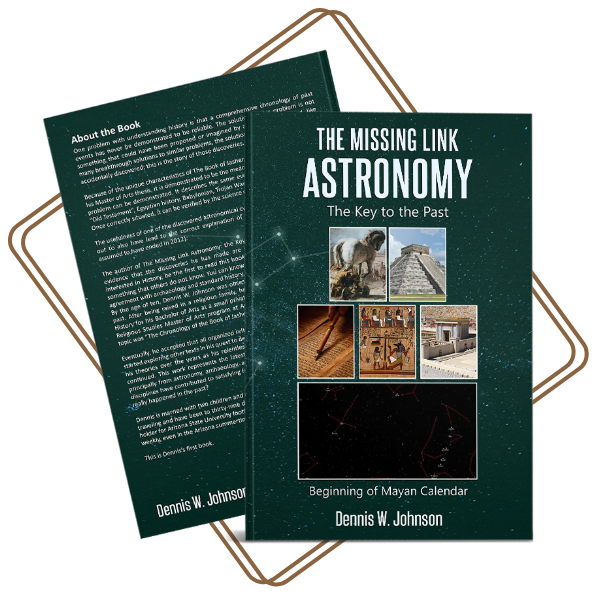
About The Book
What follows is a journey that ties together astronomy, archaeology, ancient Hebrew texts, Egyptian records, and the histories of cultures from Mesopotamia to the Mediterranean. Johnson revisits famous events, such as the rise of the Egyptian New Kingdom, the movements of Abraham and Jacob, the fall of Babylon, and the wars involving the Hittites, and asks what the night sky looked like at those moments. Surprisingly often, the stars provide answers that written records alone cannot.
A significant focus of the book is the Book of Jasher, a little-known Hebrew work that includes detailed chronological markers. By comparing these dates with eclipses, Venus cycles, and the rare alignments recorded in ancient sky lore, Johnson shows that Jasher may preserve far more historical truth than scholars have assumed.
One of the most striking discoveries in the book is an astronomical event that occurred on July 31, 1316 BCE, when Venus and Sirius rose together before dawn, a phenomenon that happens only every 1,458 years. Johnson proposes that this rare moment marked the true beginning of Egypt’s Nineteenth Dynasty, creating a solid anchor from which other ancient events can be dated with surprising precision.
The book’s strength lies not only in its research but also in its approach. Rather than arguing for one tradition over another, Johnson seeks the points of convergence among different cultures, Egyptian, Israelite, Babylonian, Canaanite, Hittite, Armenian, and even early Greek and Roman, when the sky is taken into account. The result is a timeline that feels coherent, balanced, and rooted in natural observation, rather than forced into modern assumptions.
“The Missing Link Astronomy: The Key to the Past” invites readers into a conversation that crosses disciplines and centuries. It challenges long-held ideas, but does so with humility and a spirit of curiosity. For anyone fascinated by early history or the possibility that ancient people were observing the sky more closely than we realize, this book offers a fresh and thought-provoking perspective on how the past might truly fit together.